
Spoke 02 · Model Synthesis
SEIB Studio
MBSE Design Synthesis, Agent-Assisted Drafting, and Governed Model Promotion
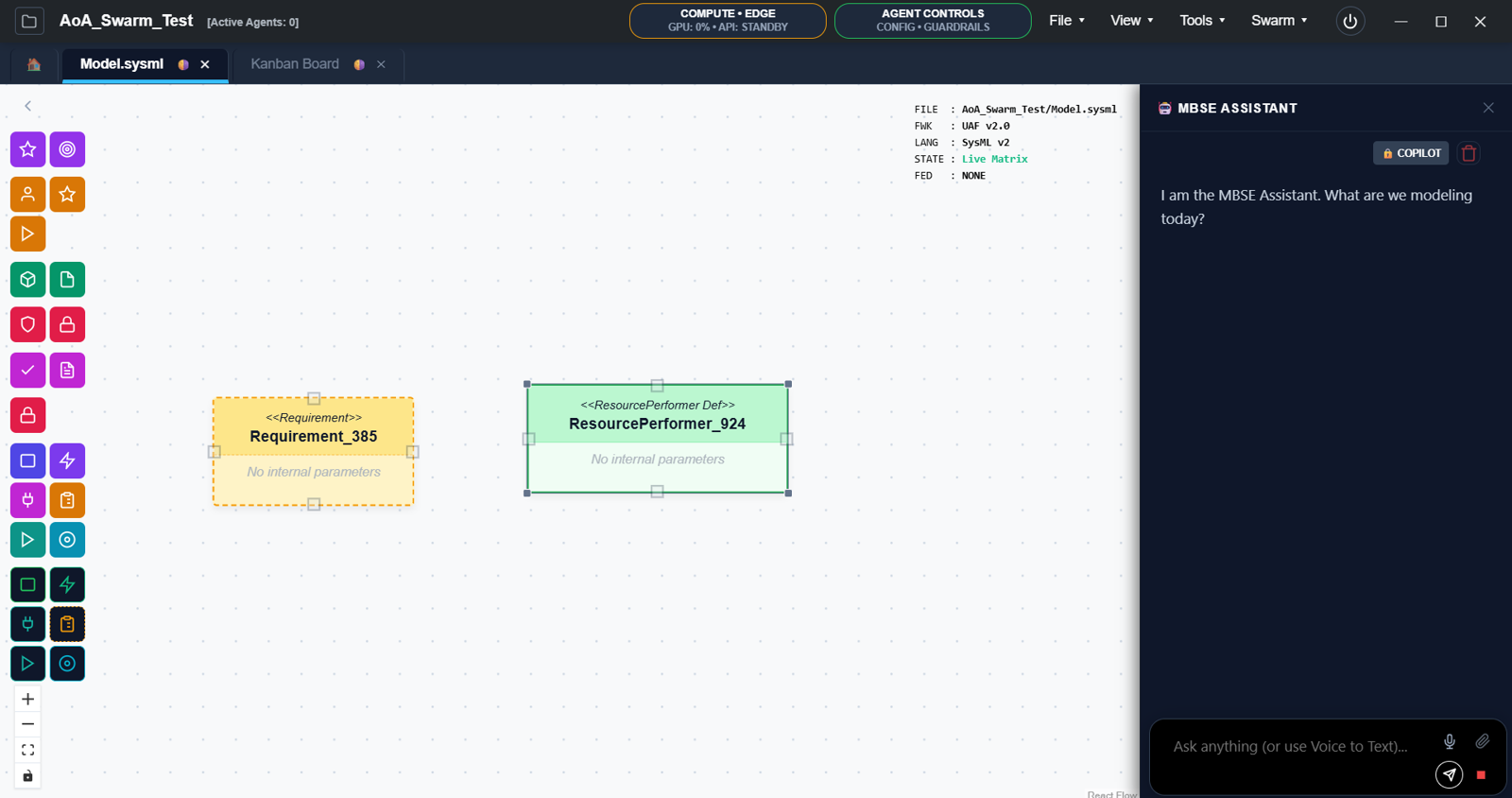
SEIB Studio is the modeling environment where systems engineers author, verify, and promote architectures. Working inside an isolated sandbox (asot/models/), multi-agent assistants draft candidate SysML structures from cited source spans without ever touching project baselines.
Modeling & Framework Support
- Process Alignment: Full lifecycle support for the Systems Engineering V-Model and the Boeing Diamond engineering flow.
- Supported Frameworks & Dialects: OMG SysML 1.4 / 1.6, SysML v2, DoDAF, UAF, and KerML schemas.
- Diagramming: Standard diagram views (BDD, IBD, Parametric, State Machine, Sequence) with automated layout and manual fine-tuning.
- Advanced Architecture: Architecture of Architectures (AoA) federation, state machine verification, and Hardware-in-the-Loop (HWIL) integration.
Operational Concept
Governed Operational Pipeline vs. Manual Conversion Bottleneck
Eliminate months of mechanical retyping. In the governed SEIB pipeline, engineers review candidate models side-by-side with source PDF bounding boxes before baseline promotion.
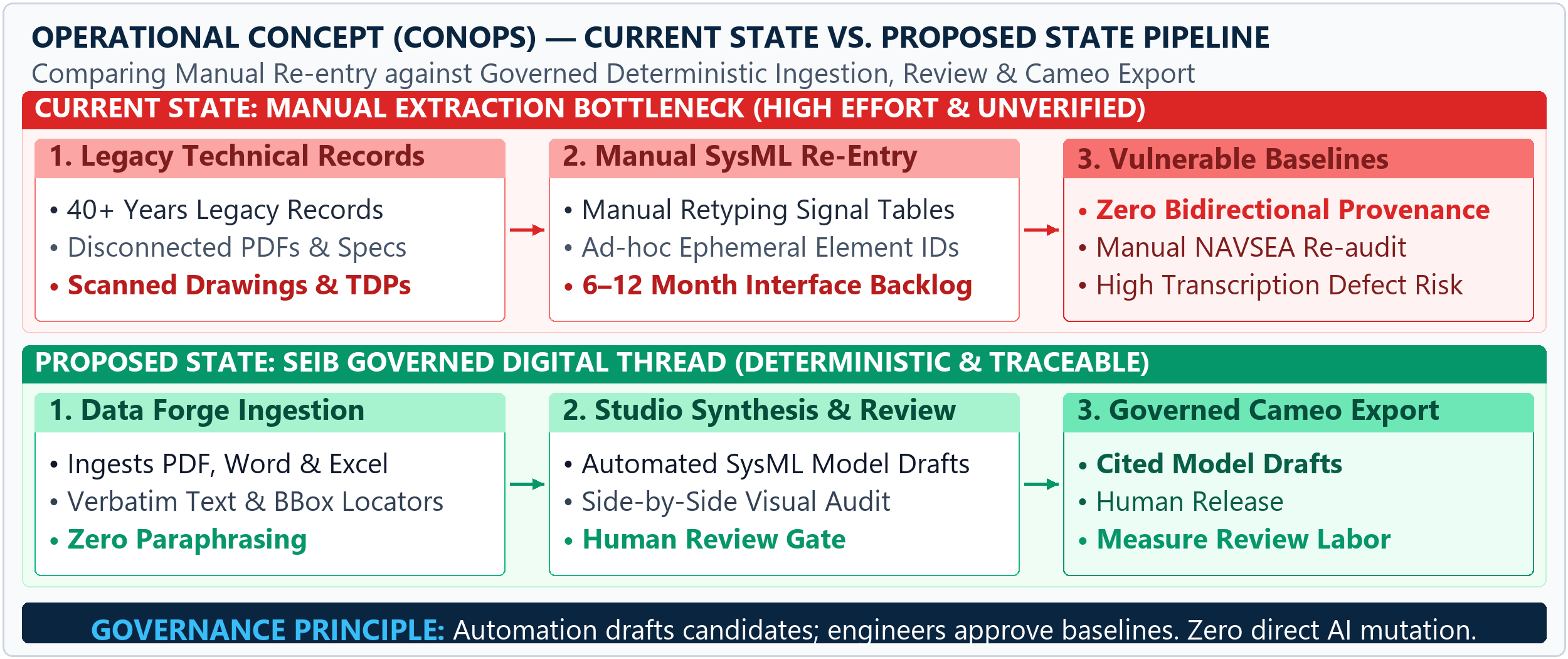
Figure 2.1: SEIB Operational Concept (CONOPS). Legacy documents are ingested via Data Forge; Studio provides a side-by-side human audit cockpit with Levenshtein character count verification; models are exported to Cameo with persistent RFC 4122 UUIDv5 identifiers.
The Human-in-the-Loop Review Cockpit
Studio replaces blind automated transcription with an interactive review cockpit designed for practicing systems engineers:
- Dual-Pane Visual Audit: The source PDF or specification page renders on the left with exact coordinate bounding boxes highlighted; the proposed SysML block or requirement renders on the right.
- Fail-Closed Citation Validation: Candidate models must include verbatim quoted spans. If a citation fails validation, promotion to baseline is strictly blocked.
- One-Click Promote or Edit: Engineers can accept, edit, or reject candidate elements individually or in batch before serialization.
Governed Cameo Reconciliation
Studio's persistent identity engine ensures seamless updates into customer toolchains:
- Deterministic RFC 4122 UUIDv5: Generates stable IDs hashed from model namespaces rather than volatile document line numbers.
- In-Place Updates: Re-exporting an updated specification updates existing Cameo model elements in place without duplicating nodes or severing traceability links.
- Reconciliation Engine: Automatically detects and flags moved, modified, split, or rollbacked elements for engineer review.
Next in the SEIB Workbench Pipeline
Explore SEIB Workflow & Verification →