
Flagship Platform
System Engineer In A Box (SEIB) Workbench
A Modular Open Systems Architecture (MOSA) environment that places heterogeneous technical data under configuration control, supports model-based synthesis with human-in-the-loop governance, and exports clean SysML directly into Cameo Systems Modeler.
One authoritative hub, narrow write paths, shared read paths
System Architecture
Modular Open Systems Architecture (MOSA) Conversion Workflow
SEIB Workbench decouples multi-modal ingestion, sandbox agent synthesis, and downstream toolchain serialization around a centralized, immutable Authoritative Source of Truth (ASOT) Hub.
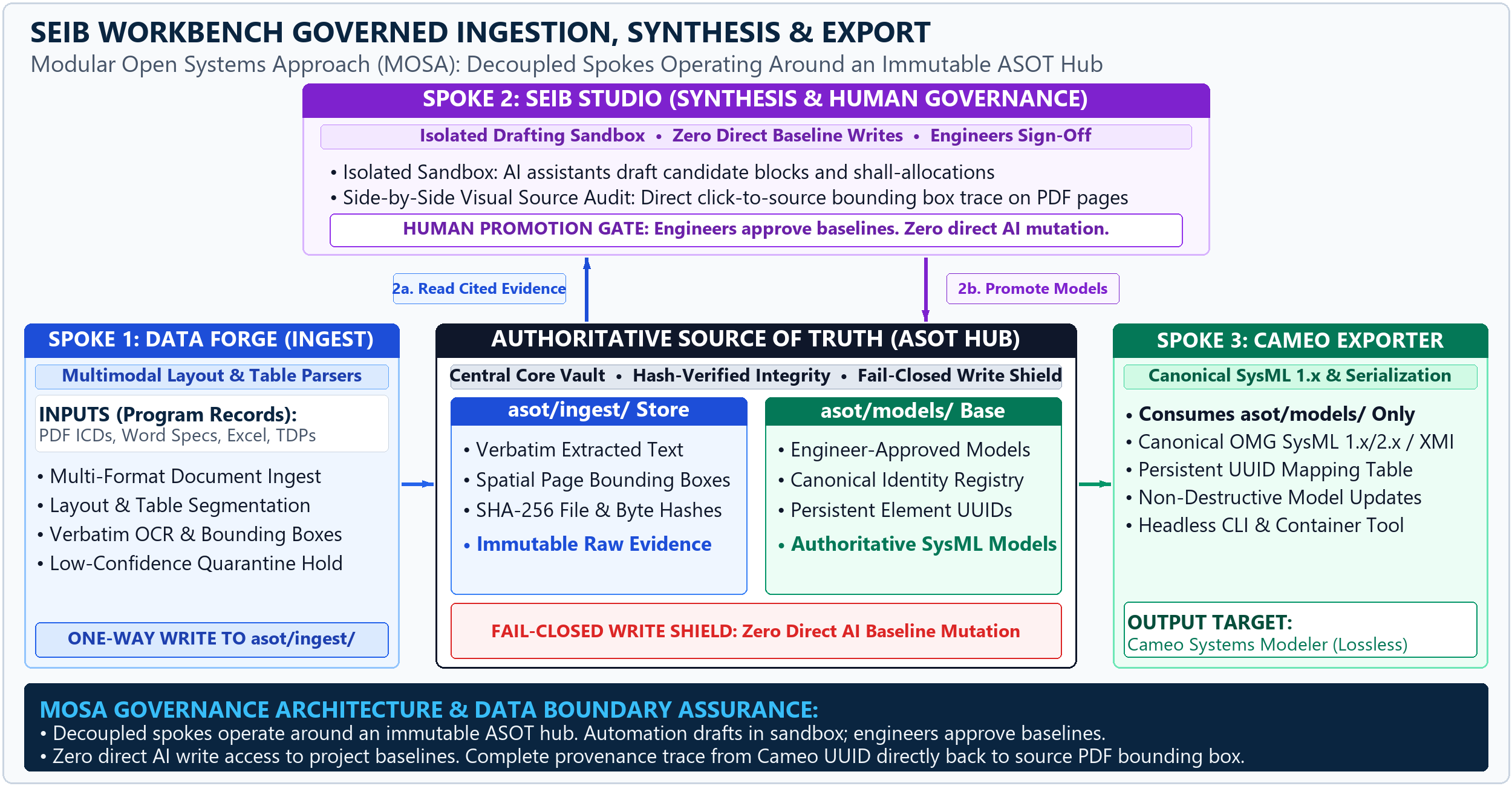
Figure 1.1: SEIB Workbench MOSA Conversion Workflow. Automated ingestion parses legacy documents into immutable cited spans (asot/ingest/); multi-agent assistants draft models in an isolated sandbox (asot/models/); engineers verify candidate baselines before persistent-UUID export to Cameo.
Source Document Authority
Legacy PDFs, Word specifications, Excel ICD tables, and P&ID drawings are ingested and normalized into verbatim text spans with coordinate bounding boxes.
- Parser-Version Hashing: Every text token and table cell is cryptographically anchored.
- Fail-Closed Gatekeeper: Invalid OCR or ghost characters trigger human inspection before promotion.
- Zero LLM Mutation: Generative models possess strictly read-only access to this tier.
Synthesized SysML Architecture
Candidate SysML v2 blocks, internal block diagrams (IBDs), port allocations, and requirement matrices synthesized from verified evidence spans.
- RFC 4122 UUIDv5 Identity: Persistent element IDs computed from qualified name paths.
- Cameo In-Place Reconciliation: Updates existing nodes without duplicating blocks or breaking links.
- Formal Write Fences: Candidate models require Human-in-the-Loop approval before export.
The Technical Challenge
The Semantic Gap: Why Chatbots & Redrawing Fail
Moving defense baselines into MBSE requires structural integrity and persistent identity. Ad-hoc tools and unconstrained AI break the digital thread.
Manual Cameo Redraw
- Extremely Slow: Weeks to months of mechanical retyping per system subsystem.
- Transcription Errors: Manual transcription regularly drops pinouts, signal types, and shall statements.
- Fragile Traceability: Hyperlinks point to static files that break across versions.
- High Labor Expense: Senior systems architects spend 90% of hours on formatting rather than design.
Chatbots & Generic RAG
- Hallucinated Baselines: Generative models invent plausible-sounding requirement shalls.
- Random UUID Minting: Every re-export assigns new IDs, generating thousands of orphan duplicate nodes.
- Zero Coordinate Trace: Plain text extraction loses tables, diagram layout, and pinout matrices.
- Uncontrolled Mutation: Direct AI write access silently corrupts project configuration control.
SEIB Governed Pipeline
- Verbatim Coordinate Bounding Boxes: Data Forge anchors every ingested requirement to exact PDF coordinates.
- RFC 4122 UUIDv5 Fabric: Deterministic namespace hashing updates models in-place without duplicating nodes.
- Fail-Closed Gatekeepers: Candidate models are automatically rejected if ungrounded in source citations.
- Human Review Cockpit: Engineers retain final-mile authority before baseline promotion.
Integrated Ecosystem
Three Decoupled Spokes on an Immutable ASOT Hub
One authoritative hub, narrow write paths, shared read paths—so agile engineering teams are not paying overhead for disconnected tools.
Data Forge
Spoke 01 · IngestDeterministic ingestion of legacy and structured sources (documents, spreadsheets, requirements modules, ICDs) into immutable cited spans with coordinate bounding boxes.
Explore Data Forge →Studio
Spoke 02 · ModelModel-based engineering and agent-assisted drafting in an isolated sandbox, with promotion gates checking candidate models against source text before baseline promotion.
Explore Studio →Workflow
Spoke 03 · ReviewContinuous verification, shall decomposition, and Verification Cross Reference Matrix (VCRM) synthesis on the same authoritative store with automated programmatic gates.
Explore Workflow →Where We Are Taking It: Full-Lifecycle Architecture
The same spine extends beyond design. Training products, maintenance data, and decommissioning records belong on the product source of truth, not in side systems that drift. We are building toward that full-lifecycle environment stepwise—named capabilities, verification against acceptance criteria, and optional export—rather than claiming unattended magic from a single prompt or forcing every customer onto an enterprise suite they cannot staff.
Capabilities Under Development (Phase II / Backlog)
The following capabilities are in active prototype development or slated for the Phase II technical roadmap. They are deliberately segmented to maintain Technology Readiness Level (TRL) honesty regarding current production capabilities.
- Full-Lifecycle Extensions: Ingest and baseline synchronization for training packages, technical maintenance orders, and decommissioning/disposal baselines.
- Containerized Navy IME Integration: Microservice deployment directly into Navy Integrated Modeling Environment host or air-gapped classified enclaves.
- Advanced MBSE Parsers: Native extraction for Enterprise Architect (EA) XMI and SysML v2 (
.sysml/.kerml). - Live Requirements Management APIs: Direct API integration with live DOORS/DNG databases.
- Classified Network Authorization: Expansion of the deployment envelope and formal ATO packages for Secret / Classified enclaves.
- Automated Agentic Artifact Generation: Autonomous workflows that continuously mine the ASOT repository to develop complex SysML artifacts, retaining mandatory HITL acceptance before final baseline synthesis.
Ready to Evaluate SEIB Workbench?
We offer structured briefings and surrogate baseline evaluations for defense program offices, warfare centers, and industry primes.
Request Briefing / Evaluation